
反者道之動: Return is the movement of the Dao. (Dàodéjīng, Chapter 40)
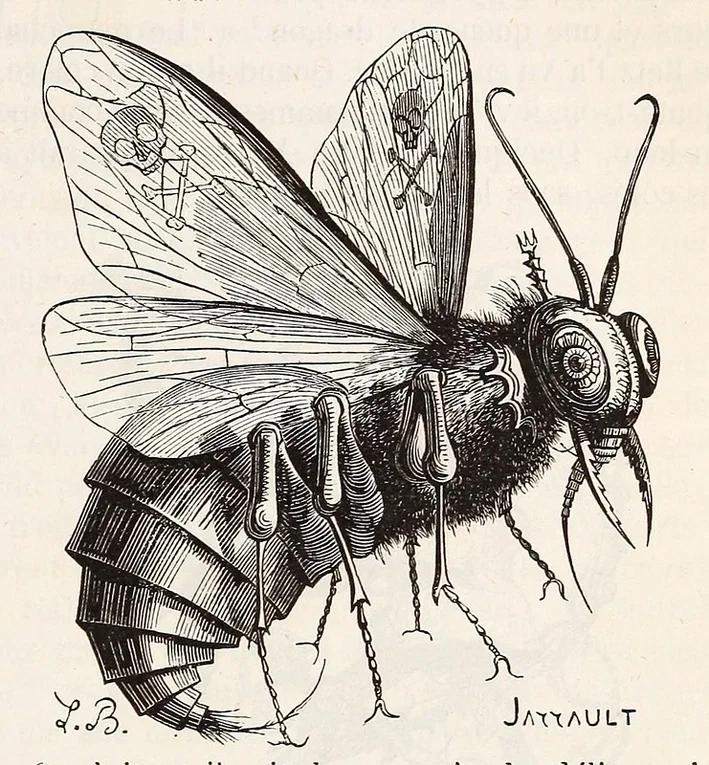
Belzebuth, from the 1863 edition of Collin de Plancy’s Dictionnaire infernal — Source.
By Mimi Young, Taiwanese-Canadian spirit medium and occultist, founder of Ceremonie, and regular presenter at Salem Witch Festival · Book a psychic mediumship reading with Mimi. · Sign up for WRONG: Yin Rites series · Last updated August 25, 2026
Is Ascension Theology Just Spiritual Bypassing and Toxic Positivity in a Different Costume?
Ascension theology can look like many things. It can look like Christian nationalism, certain about which direction God faces and who counts as saved by facing it. It can look Western-yoga-studio-shaped, or like a caption under a photograph of someone at thirty thousand feet who has found, apparently, their highest vibration somewhere over the clouds. Underneath all of it sits the same request: rise, lighten, get out of the body, get away from the residue, get away from whatever in your own history you're uncomfortable with.
And then, because I keep noticing this the longer I watch for it, ascension theology can also run in the opposite direction and still be doing the identical work: an overcoming performed where an audience can watch it happen, difficulty or shame narrated into a redemption arc with witnesses present. It can look like insisting on safety at any cost, where any discomfort at all gets filed as harm, or as feeling unsafe, full stop, no further sorting required. It can look like announcing, loudly, that what a person wants is authentic relationship, to be truly seen, except only in the specific ways that person has already decided they're comfortable being seen.
I notice, more now than I used to, how much of what gets called spiritual progress, whichever costume it happens to be wearing that week, is really just another form of greenwashing, or virtue washing, a performance of depth or goodness or humility or overcoming. Anything that doesn’t fit into some semblance of these descriptions are interpreted as as failure, or worse, as contamination, no matter how the light is dressed up to look like.
I don't think this is a fringe reading. It sits underneath a great deal of the self-help and wellness language currently in circulation, the manifestation-culture and the pew-culture and the I-am-politically-radically-enough-culture and the looks-maxxing-culture and the health-hacking-culture. Light, very ironically, does not illuminate those who subscribe to such theologies.
I want to be careful here, because I'm not trying to talk anyone out of loving light. I'm just observing that a cosmology built entirely around rising has no room in it for roughly half of what our planet does, what a body does, or a family line does, or a spirit practice does.
What Is Yin, Actually?
Western spirituality inherited Yin the way that is translated, and if you speak more than one language, you would know just how challenging and at times impossible it is to translate with fullness. In the West, we are told that Yin signifies passivity, femininity, softness, rest. I think of the spa afternoon here, oddly specific but accurate, the reward handed out once the real work is finished. It's a convenient misreading, because a Yin reduced to softness makes no claim on anyone's attention, or fear.
In the cosmology I practise and intend to convey, Yin is mutative fields of shadow, complex past the point where a term like ‘feminine principle’ has much value for. She shows up as inflection, a room dimmed rather than switched off, a process slowed, a texture thickened. She holds, in the same gesture, the seed's whole compressed potential and the pull of what's already starting to rot, and she doesn't so much act on a situation as set its conditions, which is a form of agency many European-descent magical training misses. Yin is the order that governs the dead. It's also the order that governs the inside of a body, and every threshold found in space and time.
She gathers at the in-betweens, in the interval before something happens and in the residue left once it's over. She prefers soft contact and peripheral, close range. She’s tone, pace, a shared breath, the volumes of silence. She lives in delay, in the stretch of time an output-obsessed culture writes off as wasted. She works the organs at night the way she works a cave or a well outside the body, treating the inside of a person as simply another one of her territories. And she favours enclosures that read as sealed from the outside but function, if you're actually standing in one, as apertures. I shared in a past talk with the Salem Witch Fest that the camera obscura is a Yin device.
Bright Clarity and Dark Clarity
Daoist cosmology keeps two words for seeing. 明 (míng), bright clarity, is sharp and directional, the one Western training defaults to by unexamined habit. 幽 (yōu), dark clarity, is diffuse, underground, closer to a dream. Information under dark clarity arrives sideways. It accumulates, and it blurs, in a way bright clarity finds close to unbearable, the line between a thought and an omen.
I don't think dark clarity is a lesser version of the other kind. It's a separate way of knowing things, slower, more porous, running closer to water than to fire, cave logic where the other is mountain-top logic. A practice trained only in the mountain-top version will read every slow, ambiguous, accumulating signal as a malfunction, but we are missing key data and wisdom when we think that is the only way to see.
Why Does the Dead Speak From Below? A Different Take on Necromancy
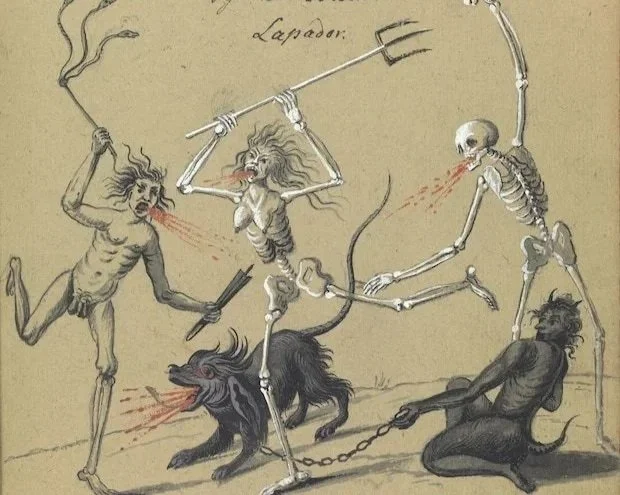
Hexagram 24 in the I Ching is named Return, 復, the one I associate with the Winter Solstice. What re-emerges in it rises from underneath, and even the light this hexagram describes is said to return from the Yin space, from below. I find I keep needing to be reminded of this, because the ascension model has the direction backward. Contact with the dead, with an ancestral pattern, with anything that has gone under, was never going to answer a call issued from above it. It’s the below that answers timing. It’s the below that answers a threshold. It answers whoever is willing to sit down at the level where it already lives, we must meet it, and not expect it to meet us.
莊子 (Zhuāngzǐ) makes something like the same claim through story instead of diagram. In the chapter called The Great and Venerable Teacher, the force he calls the great clod, 大塊 (dàkuài), the one that burdens you with a body and works you through an entire life, is the same force that eases the burden in old age and rests you fully in death. Life and death, in his telling, are stages inside a single carrying-through, the way a season carries a field through both planting and dormancy. When he drums on a basin after his wife dies and his friend Huizi is scandalized, Zhuangzi's answer is that she only moved through the transformation the seasons move through too, qi condensing into a shape and then loosening back out of it. Mourning as rupture, in his account, is simply a misreading of what happened. The dead changed position inside the system; she is not there, but still there.
What Does Staying In the Light Actually Cost You? On Decolonizing SpiritualityHow does it Relate to Spiritual Bypassing?
Ascension theology isn't only a claim about directionality. Ultimately, it’s a claim about rank. Up got built, as something superior to down, roughly the same centuries and the same contact through which white got built into a colour standing for purity, and dark into a colour standing for threat, or sin, or a savagery whiteness got to define.
The missionaries who told the ones who came before me that their ancestor altar amounted to darkness needing illumination was reaching to file and rank souls, and that a colonial administration used to sort populations. Light meant civilized, correct, saved, clean. Dark meant backward, contaminated, wrong, damned. That sorting began with gender, and then through the belief that one’s belief is more up than another, that same sorting continued with race. Notice the load-bearing vocabulary in spiritual language that likes to describe itself, these days, as post-religious. Notice the sorting.
Contemporary spirituality tends to believe it left that assumption behind when it left the church. I don't think it did. I think it rebuilt the identical hierarchy just inside the exit, and called it vibration now, or frequency, a level a person is meant to be operating at, a number consciousness is meant to clear before anyone will grant that it's legitimate. New Age spirituality rewards rightness and politeness, guards comfort, and simultaneously avoids discomfort, particularly the harmed’s discomfort at all costs. Again, notice the sorting.
Beyond the New Age and into more ‘serious magic’ traditions, the practitioner trained only in invocation, in naming and calling and commanding, tends to summon presences that were already close by. Ancestors who never actually left get addressed as though retrieval were required, which manufactures an obligation that didn't need to exist in the first place. Naming is what creates the tie, not the presence itself, and a practice with no category for Yin reads everything that lingers as either a threat to be banished or a spirit to be commanded. Command is what a hierarchy trains a person to reach for automatically, because a hierarchy has no place in its own logic for a relationship that isn't organized around who outranks whom.
A cosmology that only rewards ascent, that only counts a session as successful once it resolves into something clean and provably good and worth posting, produces practitioners who are ascension-minded, who sort. I don't think that's a spiritual failing in any individual practitioner. I think it's a cost built into the design, and the design, on both its halves, was imported: a theology that needed purity as proof of salvation, a science that needed measurement as proof that something existed at all.
And let’s talk about science. Science, currently only takes what’s visible or measurable seriously, and the devices it relies on are constructed with light. Currently, astrophysics cannot prove or disprove dark matter because no instrument exists to directly observe and measure darkness. What is understands about dark matter is only through inference, the peripheral quality I referenced about Yin earlier.
What Would It Mean To Practise Yin?
A practice conditioned by Yin asks for a different rigour, and I want to underline different, because I don't mean less or better. No state reads as more advanced, more evolved, further along, because Yin was never organizing the field vertically to begin with, and her fields of complexity that isn't organized vertically has nowhere for a hierarchy to apply. In fact, the rules that apply in ascension theology are dismissed and rendered ineffective, because Yin is about returning to origin, to root, to blood, to bone, to post visibility; she has the final say.
The I Ching offers a reframe here I keep coming back to. A Yin line is drawn broken, ⚋, and a reader trained on bright clarity, trained to read purity as wholeness and any gap as damage, assumes the break means something incomplete, or defective. The line has a gap in it, and the gap is what makes it open rather than sealed. Applied to contact with anything that has gone under, the uncertainty a practitioner feels, about whether they're really in contact with something or only imagining it, is often what real contact actually feels like from the inside, before it's been cleaned up into a story with proof attached. It's a permeable state.
An ascension model wants proof before it will believe anything is real. A Yin practice treats the demand for proof as the obstacle standing between a practitioner and the information that's already arriving. An all-Yang practice is filled with user error.
What Do Perverse, Evil, Wrong, and Rot Actually Mean Under Yin? Your Villain Era, Reconsidered
I've been sitting with the word wrong for a long, long time. Wrong shares a root, several centuries back, with wring, with a twist, with something bent out of true. Before it meant morally bad it meant crooked, off its line, facing away from the direction it was ‘supposed’ to face. That's a description of position, and it's the same domain Yin governs. There’s the right-side-up of Yang and the up-side-down of Yin. Ascension culture is quick to misread and misterm the Yin.
Perverse carries a similar history, per in Latin, through or thoroughly, and vertere, to turn. To pervert something, in the oldest sense available to me, is to turn it all the way around, to send it back the direction it came from. I keep thinking about how precisely that describes 反, fǎn, the character that means both return and reversal in the fortieth chapter of the Dàodéjīng, the same character I already leaned on to explain why the dead come back at all. If turning back is what the Dao does as a matter of course, and perverse just means turned around, then perversion reads less like a deviation from the natural order and more like a fairly exact description of what the natural order is already doing.
I'm not arguing that harm doesn't exist, or that discernment should never apply to anything. The claim I'm making is narrower, about what evil, specifically, requires in order to function as a category at all. Evil needs a defendant. It needs a fixed, sorted, legible self, standing still long enough to be pointed at and named. Yin doesn't hold still in that particular way. She subjects identity to ambiguity, keeps a figure cloaked in enough half-light that other figures underneath it get room to surface. I've come to think of her as the victorious submissive, where conquest hides itself inside what looks, from the tribunal's seat, exactly like surrender. God is only God if it has a worthy adversary, and I can’t help but wonder if God needs the Devil to stay God. Why is goodness so obsessed with goodness? Take the adversary away and victory has nothing left to be victorious over (yet another example of upness). It kept needing a contest, a legible opponent, a scoreboard, someone to have lost by the end of the story so someone else could be confirmed as having won.
A contest needs a witness, or at least a mirror, and I keep picturing the mirror-check itself, the hand along the jaw, the angle adjusted, the search for confirmation that the good thing is still visibly, provably there. That's ascension’s approach, turned on a self instead of a room, spot light it, from an angle chosen for effect, and call the resulting reflection virtue. Yin is not invested in optics. Compost doesn't strike a pose. Whatever she's doing in the dark, she's doing it with no one confirming it happened, which reads either as the least vain arrangement in the whole cosmology, or as the one form of completion a culture addicted to its own reflection has no instrument left for measuring.
The heretic, the villain, the perverse, rot, wrong, and so forth, under ascension theology it can only file under evil or wrong, because the light is largely lacking in originality. My series, WRONG: Yin Rites as Heretic, Villain & Perverse is an 8-part series of creative work, rites, and media study considering dark complexity and the infinitely misunderstood as sources of originality and return.
Where This Continues, Leaving Church and Missing Ritual
In the WRONG: Yin Rites series, I’m interested in treating the villainous and heretic as positions with their own intelligence, their own claim on a reader's attention, their own right to a body of work built around them instead of needing an redemption arc imposed on them from outside.
If any part of what I've written here named something you already half suspected about the spiritual language and ideologies you were handed, the series is where that suspicion gets a method to work with.
Enter code WRONG for $100 off the single payment option, or WRONGPLAN for $100 off the three-month payment plan, through December 12, 2026, end of day PDT.
If the I Ching references in this piece are new to you and you want the groundwork first, Finding I Ching Clarity is the place to start.
And if you'd like this kind of writing in your inbox before it goes anywhere else, join the list.
Frequently Asked Questions About Yin
-
Darkness, in casual usage, names an absence of light. Yin names a governing function: rest, concealment, interiourity, and return, operating through modulation rather than absence. Yin is a condition that shapes what happens next, not a lack of anything.
-
Dark clarity is a mode of perception distinct from bright clarity (明, míng). Where bright clarity is sharp and directional, dark clarity is diffused and accumulative, arriving from the side and building over time. It does not resolve in a single directional insight.
-
It means recognizing that "upward equals good, downward equals bad" is a specific cosmological claim, not a universal law, and one that arrived through missionary and colonial contact in many of the places now practising it as self-evident. Decolonizing means restoring the older logic, return, threshold, ancestor continuity, that ascension theology was designed to replace.
-
Light-over-dark and up-over-down were fused with racial and civilizational rank during the colonial period (and still persists in the present day), when missionary and administrative language described colonized peoples and their ancestral practices as darkness needing illumination. Contemporary spirituality inherited that rank without considering the history behind it.
-
WRONG: Yin Rites is an eight-part series by Mimi Young of Ceremonie combining creative writing, rites, and media study, built on Daoist Yin cosmology and organized around the notions of heresy, the villainous, and the perverse.
Following the spirits,
Mimi
Mimi is an occultist and animist-spirit medium offering psychic mediumship readings and education on syncretic witchcraft and Daoist divinatory practice. She was born in Taipei, raised in a Taiwanese household on the westcoast of Canada. She also teaches AI-search and SEO strategy through Words That Work. Read more about Mimi.