
What Is Spiritual Bankruptcy? And How Does It Differs from Spiritual Bypassing?
Spiritual Bypass Meaning: When Avoidance Becomes a Complete Self-Concept
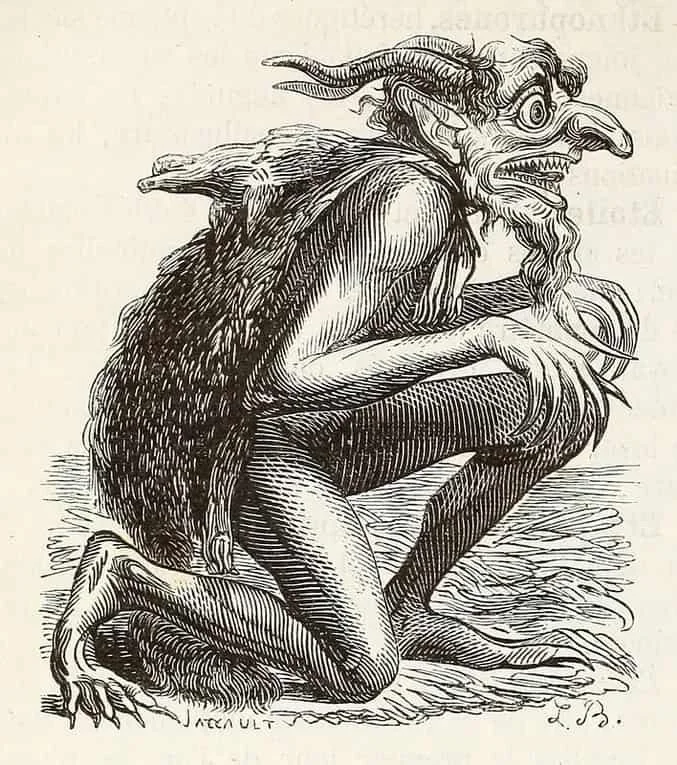
Eurynome, from the 1863 edition of Collin de Plancy’s Dictionnaire infernal — Source.
Performative Spirituality and the Performance of Practice
Using the word bankrupt as both noun and adjective, it is defined according to Merriam Webster, as, “a person who is completely lacking in a particular desirable quality or attribute” or “exhausted of valuable qualities”. The word comes from Italian, banca rotta, meaning broken bench.
So if we were to apply the word spiritual with bankruptcy, I would use that compound term as performing connection to the Unseen, or performing transformation without undergoing the demands of the practice.
We live in troubling times, where unjust and unrelational patterns of expression persist no matter where you look, including in spiritual and progressive communities. One can have the vocabulary, the aesthetic, the access to groups and credentials. One can attend rallies, participate in retreats, conduct divination, burn herbs, cite and recite great writers. Is all of this practice, or is it the performance of practice, a self-concept that confers social standing while requiring nothing verifiable underneath?
Spiritual bypassing, a term introduced by psychologist John Welwood in 1984, describes the tendency to use spiritual ideas and practices to sidestep unresolved emotional wounds, personal accountability, and the demands of being in relationships.
Spiritual bankruptcy is what happens when bypassing becomes the perspective of an entire self-concept, a system so complete it no longer needs to avoid the work because it has learned to perform the work instead, to the degree that it often does not recognize it in itself.
Spiritual practice in any serious tradition makes the demand that we become more truthful as a fruit of committed practice. The sacred is meant to implicate us, arouse accountability in our perspectives, behaviour and relationships, and dissolve the performed self rather than decorate it with more trophies. Mystery, when we are willing to respond to it, should decolonize us not only from systems of patriarchy, whiteness, and colonization, for they are offsprings of the same parent, the parent of severance from being in-company-with, or a more specific word, sympoiesis, and what can be more in-company-with as animacy?
So when we tread upon sacred ground and the impulse is to weaponize it or exploit it, we repeat the very systems we claim to resist. Because the sacred will ask us to be wrong, to be corrected and through that confrontation, we can mature, become more responsive, and renew. Spiritual bankruptcy is adopting the appearance of such, while avoiding the making-together that animacy invites us into, while avoiding the spirit of it all.
When Spiritual Bypassing Becomes a System
Feelings become authority, emotional experience cannot be questioned without the questioner being positioned as harmful
Intuition replaces discernment
Intent displaces impact, the gesture was well-meaning so its effect on another person becomes optional to examine
Identity labels replace inner development, calling yourself conscious, feminist, socialist, spiritual, or witch does the work that actual embodiment would otherwise require
Suffering or wounding becomes currency, performed rather than metabolized
Discomfort becomes harm, so accountability can always be refused on those grounds
Shadow work gets referenced and rarely done
“Need to protect my energy” is a convenient escape hatch
The Operating System of Spiritual Narcissism
Lived experience becomes the only valid knowledge, producing incuriosity about anyone whose experience differs, which reinstates whiteness it claims to dismantle
Complexity reduces to binaries
Emotional labour, capacity, trauma history, or neurodivergence gets named often to avoid doing any work. Identity categories become unimpeachable.
Spiritual Bypassing, Performative Activism and the Relational Moves
The announced gesture matters more than the sustained, unwitnessed one
Therapy language, spiritual language, political language deployed as exits from conversations that should continue
Positions held for social legibility rather than examined conviction
Disagreement becomes threat instead of an opening for mature, human conversation
The altar, the retreat, the correct influences, the right books stand in for the inner work those things were meant to catalyze
The “right” thinkers get cited without engagement with what they actually argued for or demanded
What Spiritual Bankruptcy Looks Like
Fluency in the language of depth without the depth itself
High sensitivity to being perceived as good, very low tolerance for evidence that contradicts that perception
An inability to be wrong without collapsing into shame, because the system always provides an exit that restores moral standing without requiring change
Correction received as aggression, a different view treated as an attack, because the self-concept cannot distinguish between being challenged and being harmed
Punishment delivered indirectly, withdrawal, surveillance, performed warmth in public and quiet hostility in private, always with enough deniability to avoid accountability for any of it
Gestures that read as generous on the surface and function as extractive underneath
Narrative revision as a survival strategy, the story gets rewritten until the self emerges blameless, and repeated until it becomes genuinely believed
Smugness as a substitute for sovereignty
The practice becomes a preservation system for the existing self, and sadly, by clutching to one's pearls, all abundance and life processes are lost.
This is why spiritual bankruptcy so often produces behaviours indistinguishable from the systems it claims to resist. Severance from the animate dark generates the same symptoms regardless of which esoteric tradition or politics it claims to align to.
If this essay named something you recognize, in your community, or even within yourself, the recognition is already a potent start.
WRONG: Yin Rites as Heretic, Villain and Perverse is an eight-week creativity series that takes the charges so many fear, including darkness, heresy, pollution, evil, and treats them as territory one can traverse instead of verdicts to avoid. The series is not interested in offering acquittal from wrongness back to rightness. The work is about contemplating the spiritual understanding behind each charge, so that one can re-animate with the Dark, with Shadow, and come back to life.
Following Yin,
Mimi
Animist psychic medium and occultist