
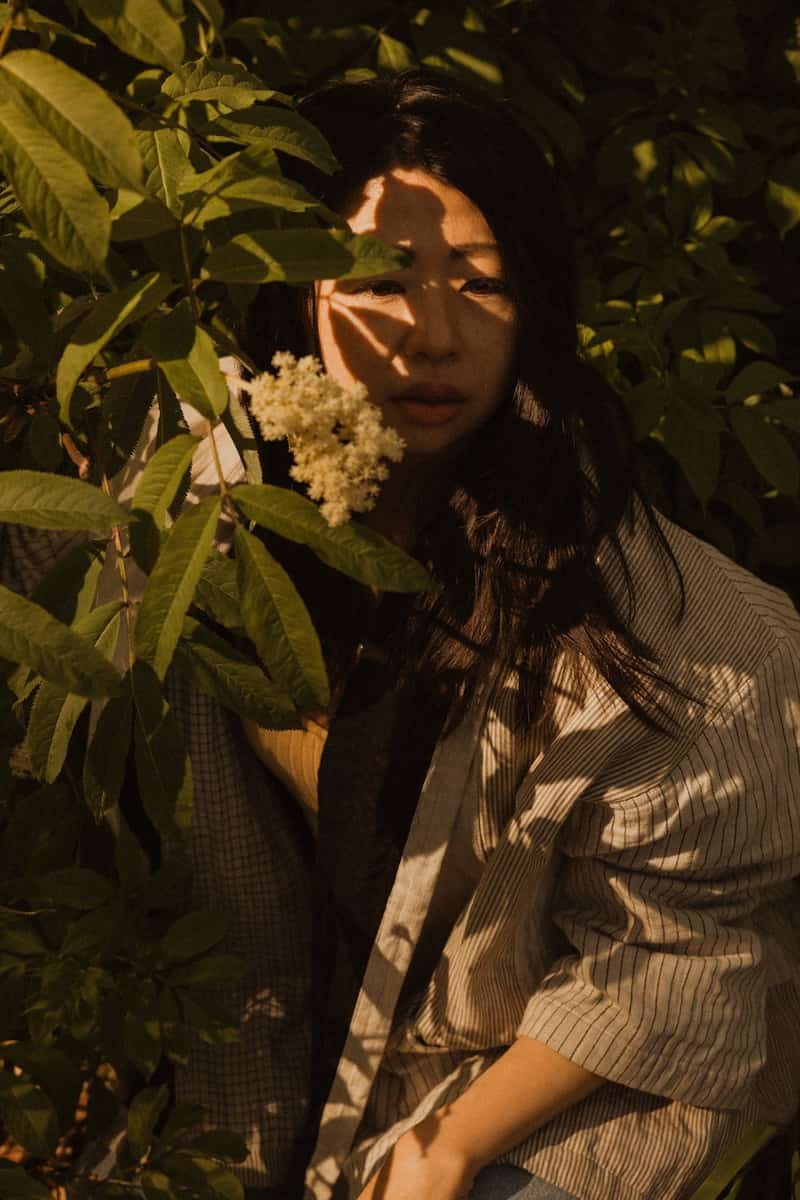
Animist spirit medium, Mimi Young, shares how the solar eclipse made her more psychic, creative, and relational
Beyond the splendour of the astrological event, an eclipse is acupuncture for the collective, affecting the human, the more-than-human, the living and more-than-living. If you have observed animals during an eclipse, they act a bit zany. Birds chirp and fly around in what seems like more chaotically. Cows stop doing what they’re doing in fields and walk back to their barns. Dogs bark and chase invisible things. Acupuncture’s function is to move stagnant or blocked qi (sometimes spelled chi) or energy in our energetic pathways. On a collective level, these energetic pathways can include our modes of transportation, modes of communication, family and cultural stories and customs, and sites, organizations, and meeting places that represent intersection of ideas. Since it was a solar eclipse, the Moon did the work, meaning the cosmic acupuncture has or bring up emotions, particularly with memories / past, how these emotions show up relationally, and how they can also inspire us to speak the words that up until now, have been left unsaid.
According to the I Ching (also known as the Yi Jing), the trigram that leads to moving things along and change is Thunder. Thunder is an agent of change. It moves things along, and functions as the acupuncture within the I Ching oracular system. In this way, the eclipse is an invitation to change as well as a premonition of change. It asks us who we are, what we need and want going forward, and reminds us that to take ownership in our stories. Nothing changes if nothing changes. In this way, creativity is change, change is creativity, and the eclipse brought the conditions to look deeply for what needs to shift.
For me, I wound up spending some time preparing for the 8-part container that intersects writing, creativity, and the spiritual, titled Black Holes Birthing Stars. The theme of relating animistically with my words felt ripe. I was ready to speak to the words themselves, and not only human words, but words that belong to plants, the elements, and the departed. I share below an excerpt:
Tell me, what do you wish to speak?
This can be a human language, as well as a more-than human-language.
For me, I would like to speak the language of roses. Buttery petaled, heady fragrance, yet boundaried.
I would love to better speak the language of trees, where I can learn to lean into each other as a forest more. Where as trees when they are approaching the end of their life as an individual, they give back their nutrients to the soil to the ecosystem of the forest and upon death, the tree completely surrenders itself by exchanging its individuality to be part of the whole of the forest, part of the forest floor, knowing its nutrients offered will show up in neighbouring trees, and also trees that have not yet come.
Of all the trees, I would love to continue my language lessons with Tea. How when I speak with her, she treats me as if I am the only one, and how we have all the time in the world.
I desire to learn the language of dandelion. Its optimism, and its ability to move the stored anger out of the liver.
I yearn to learn the language of rain, how it pours out itself, and joins other bodies of water, how it then evaporates, and then pours down again. I am shown that through rain, time is always cyclical, but never uniform. The swelling and releasing of the clouds are different every time, sometimes sudden and sometimes gradual, and how they are distinct from each other. How sideways rain is rain being defiant and unrelenting. Spring thunderstorms are so enthusiastic. Summer mists tease and smell so good. Fall showers are heavy and thick. Winter’s heaviness, rivers on dry land, in cities, and when it cools right down, right down to zero, how they crystalize and turn to snow. How snow is a different kind of rain, one that rocks and hushes the land beneath. Snow as comfort, snow as delight, and sometimes, snow as treachery.
Tell me, what do you wish to speak?
I also wish to speak the language of Justice as in the one that’s found in the Tarot, one where accountability, where reparations, and where restoration are the consensus. Where it’s not about retribution, punishment, penalties, and cancelling. Yet, where accountability is a value, where we understand our personal intent and impact, and our willingness to make things right when harm is caused, where closure is prioritized, where accountability is a unified commitment towards dignity, safety, and diverse purpose.
This kind of justice in my heart of hearts is not about the human, but it’s to centre the more-than-human, with humanity’s role as collaborators and participants. Justice as a guarding against exceptionalism or entitlement or in thinking we are always the main characters or the hero. Justice, as a language that is shared where the whole is ripe and thrives. Justice then reminds us that ownership is about our actions, not possessions. To act with justice is to take ownership. Not to weaponize, but to disarm.
I long not only to be fluent in these languages, but I crave for leaders, thinkers, doers, creators, healers, around me to also speak these languages more. Language spoken to oneself is meaningless. What is language without sharing it and receiving it?
Tell me, what do you wish to speak?
To the trees I never thanked enough,
To the roses I never smelled enough,
To the teas I haven’t yet sipped,
Please teach me your ways, your words, your language.
May I listen and practice and get up again each time,
as trees grow tall,
as roses smell sweet,
and as assuring as a cup of tea.
Mimi
Animist spirit medium and founder of Ceremonie
PS. This was part of our practice in Black Holes Birthing Stars, a 8-week container that intersects animism, creative ritual, and transformation.