
The I Ching Is a Map, Of Every Position That Already (and Could) Ever Exist
On I Ching Readings, George Boole & the Six Dimensional Map
What is the I Ching?
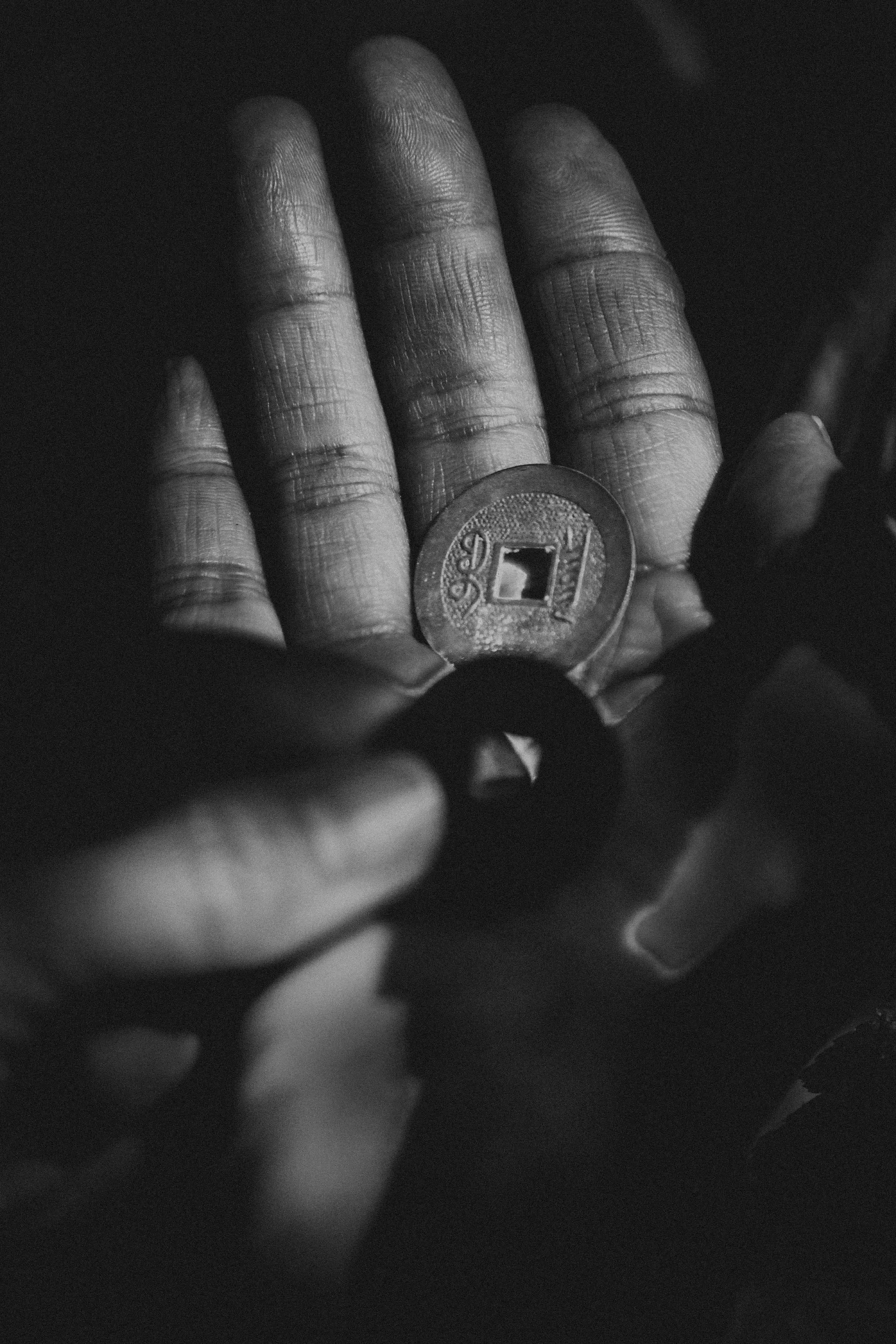
The I Ching, known in English as the Book of Changes, is an ancient Chinese oracle system with roots going back over three thousand years. A reading works by the querant tossing coins or yarrow stalks, which generate a six-line symbol called a hexagram. There are sixty-four hexagrams in total. Each one describes a state of change, in other words, where a situation is, and where it is moving. The I Ching is used for divination, for decision-making, and as a philosophical and cosmological framework rooted in Daoist thought. The I Ching is the cosmological foundation from which Traditional Chinese Medicine, Feng Shui, and BaZi astrology (Chinese Astrology) all draw.
How do you do an I Ching reading?Begin by forming a clear question, then cast either three coins or a bundle of yarrow stalks six times, once for each line of the hexagram. Each throw produces a Yn or Yang line, built from the bottom up. The resulting six-line symbol is your hexagram. If any lines are "changing," those indicate movement, then the hexagram is shifting toward a second one, called the relating hexagram, which shows where the situation is heading.
Reading the hexagram well requires knowing the structural grammar of the system: what each line position means, how the two trigrams relate, and what the changing lines are telling you about direction and timing. That is what Finding I Ching Clarity teaches.
The first time I threw the coins and received a hexagram in an I Ching reading, I did not think about mathematics. I thought about the image, of the trigram Water over Fire, or Thunder beneath Earth, or the lone Yang line sitting at the base of five Yin lines like a match being struck in a dark room. The images are what most people come to first, filled with sagely meaning. But after years of working with the I Ching, I’ve realized that there’s something strange, something more, something that feels awe-inducing.
The I Ching maps every position you could ever find yourself in, every transition you could ever be moving through, every state that could ever be obtain. You locate yourself through an I Ching reading. Stay with me, so I can trace it here.
Begin with the simplest possible thing
Back to the math. A single point has one position. Drag it in any direction and you get a line, with two endpoints. Now, drag that line perpendicular to itself and you get a square, with four corners. Then drag the square perpendicular to itself and you get a cube, with eight corners. Stay with the cube for a moment. You know a cube, you can picture one, you have seen them, likely have held one (such as rubics cube). Each corner in a cube is a unique position in three-dimensional space. Each edge connects two corners that differ by one coordinate.
Now conceptually, drag the cube into a fourth dimension. You get a shape with sixteen corners. You might not picture this as easily, but the logic holds. Each time you add a dimension, the number of corners doubles.
This means that in the fifth dimension there are thirty-two corners; the sixth dimension there are sixty-four corners.
George Boole was a nineteenth-century mathematician and logician who formalized binary logic—the mathematics of yes and no, on and off, two states and their combinations. He was not thinking about Daoist cosmology, but the structure he described is the same structure the I Ching had been operating on for millennia before he named it.
The I Ching has six lines. Each line is binary—yin or yang. Six binary variables produce sixty-four combinations. The shape that holds sixty-four corners in six dimensions is called a hypercube. The I Ching is one.
What this means for the hexagrams
Every hexagram is a corner of that shape. I don’t mean this metaphorically. Yes the hexagrams are presented as symbols, but in reality, they not only take up space, they are space. A specific and unique position on a hypercubed map.
Each corner has exactly six neighbours. Those six neighbours are the six hexagrams you can reach by changing one line. One line changes and you have moved along a single edge to the immediately adjacent position. Two lines change and you are two edges away. Six lines change and you have crossed the entire diameter of the space, from one corner to the corner furthest from it.
Hexagram 1 is composed of six Yang lines, and Hexagram 2, six Yin lines. They are not mere opposites in meaning because spatially, on the map, they are opposite corners of the hypercube, the maximum possible distance apart in the entire structure of space time.
When a reading moves you from Hexagram 1 to Hexagram 2, or anywhere close to that distance, you are crossing the full width of possibility. That is in the geometry, which of course, informs the interpretation. The land always informs the interpretation.
The changing line within the I Ching, reconsidered
It is common for introductions to the I Ching treat the changing line as a secondary result, and they tend to treat it as a modifier or an addendum. In the structural reading, it contains instructions on where to turn on the map. A changing line tells you which edge you are on, and it’s not just where you are, but which direction you are moving. The relating hexagram is the neighbouring corner you are heading toward. You are being shown your trajectory through the map.
This is why experienced practitioners find the I Ching increasingly useful the longer they work with it, and why it resists casual consultation. A casual question gets coordinates back. If you do not know how to read coordinates, an I Ching reading is hella confusing. If you do, they show you something about your current position in the structure of space time possibilities. You can understand where you are, what is immediately next to you, how far you would have to move to reach anywhere else.
What the map cannot do
The map is complete in its structure because it holds every possible position. But just because it shows you possibilities and likelihoods, what a map cannot do is move you through it. That is your work, and the work of time. An I Ching reading tells you where you are and what is adjacent. It does not tell you whether you will move, how fast, or what you will do when you get there. The I Ching is indifferent to your preferences on all of those questions. That’s the whole point, so that the wisdom it grants you is outside of yourself and your biases.
On studying it seriously
I teach the I Ching as a system—its Daoist cosmological context, its mathematical logic, its line dynamics, and its relationship to animism— in a longform monthly series called Finding I Ching Clarity. The series is underway and still open for registration. If this framing is the one you have been waiting for, please join us.
If you want to work with the system directly in a reading, I offer Shamanic Mediumship readings that draw on the I Ching alongside other divinatory forms.
Following the spirits,
Mimi
Spirit medium and occultist